Troubleshooting
Generic ("it doesn't work")
-
Confirm that the VS Code extension and the Python module
ocp_vscodehave the same version. Both show in the OCP CAD Viewer UI, and the Output panel logs the check:extension.check_upgrade: ocp_vscode library version 4.0.2 is compatible with extension version 4.0.2 (major.minor match) -
Test whether the standalone OCP Viewer works, to eliminate VS Code issues.
- Open a work folder rather than a single Python file, to rule out Python path problems.
- Check the Output panel (menu View → Output, select "OCP CAD Viewer Log" from the drop-down) for:
PythonPath: '...'— the correct Python executable and environment?OCPCADController.startCommandServer: Server listening on port ...— the correct port? Default is 3939.OCPCADController.start: Starting websocket server ...— should not be followed by an error.ocpCadViewer.ocpCadViewer: OCPCADController started with port ... and folders: ...— the correct working folder?
- If all looks fine so far, toggle Developer Tools1 in VS Code and look in the Console tab for errors related to
three-cad-viewer.esm.js,three.jsor WebGL.
Reliable Python detection
The extension depends on VS Code using the correct Python interpreter. The most reliable ways: start VS Code from the command line in the desired Python environment, or select the interpreter in VS Code first via the Python extension's "Select Interpreter".
RuntimeError: Cannot access viewer config. Is the viewer running?
The additional warning at the top of the stacktrace says:
UserWarning: The viewer doesn't seem to run: Port could not be cast to integer value as 'None'
- Is the viewer running? ⇒ Restart the viewer.
-
Check
~/.ocpvscode. With two viewers running, it should look like:{ "version": 2, "services": { "3939": "", "3940": "" } }⇒ To reset it, replace its content with
{"version": 2, "services": {}}— it is rebuilt when a viewer restarts. See Addressing a viewer for how the registry is used.
UserWarning: The viewer doesn't seem to run: [Errno 61] Connection refused
Are you using the right port? The Viewer Manager shows which port the viewer is running on:
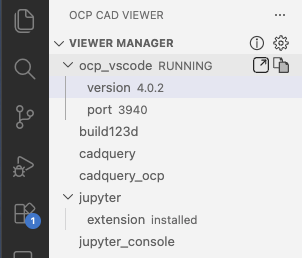
(For the standalone OCP Viewer, the port is in its startup output: The viewer is running on http://127.0.0.1:3939/viewer.)
⇒ Given that port, set_port(3939) or show(objects, port=3939). If the objects still don't show, restart the viewer: close the viewer tab (it cleans up behind itself) and start it again.
CAD models are (almost always) invisible in the viewer window
three-cad-viewer.esm.js THREE.WebGLProgram: Shader Error 0 - VALIDATE_STATUS false
Program Info Log: Program binary could not be loaded. Binary is not compatible with current driver/hardware combination.
VS Code's internal browser caches compiled WebGL artifacts like shaders. After a graphics driver update, the cached compiled version may not fit the new driver, producing this error. Solution: delete the VS Code browser cache — see e.g. this guide for the per-OS locations.
Configuration looks unexpected on the splash logo
Do not use the splash logo to verify your settings: the logo overwrites all settings with its own, to always look the same on every instance. ⇒ Use a simple model of your own to check your configuration.
-
Use shift-cmd-p (Mac) or shift-ctrl-p (Windows/Linux) and select Developer: Toggle Developer Tools. ↩